IPTV (Internet Protocol Television) delivers live television and on-demand video over your internet connection using the same TCP/IP packet-switching technology that powers the web. Instead of relying on coaxial cable or satellite radio waves, IPTV encodes video into data packets, routes them through standard internet infrastructure, and reassembles them on your screen in real time.
This guide breaks down exactly how IPTV works under the hood, compares it against cable TV and OTT streaming platforms, and evaluates whether a premium IPTV subscription delivers superior value for cord-cutters. We analyzed infrastructure requirements, real-world performance data, and total cost of ownership to provide an unbiased, technical verdict.
Executive Summary: IPTV
Best For
Cord-cutters & sports fans wanting 4K live TV at 70–85% lower cost than cable
Standout Feature
24,000+ live channels with adaptive bitrate streaming across every device
- ✓ IPTV uses unicast internet streaming, not broadcast signals, enabling pause, rewind, and catch-up on any screen
- ✓ Premium IPTV costs $12–20/month versus $70–150 for a comparable cable package
- ✓ Requires a stable 25+ Mbps connection for buffer-free HD and 4K playback
Quick Navigation
What Is IPTV and How Does IPTV Work?
IPTV is a content delivery architecture where television programming travels as encrypted IP packets over managed or unmanaged networks, rather than as radio frequency signals broadcast through the air or pushed through coaxial cables. The "how does IPTV work" question is best answered by understanding the three service formats it enables:
- Live Television — Real-time broadcast streams, identical to what cable delivers, but transported over IP.
- Video on Demand (VOD) — A stored library of movies and series that users can play instantly.
- Time-Shifted TV — Catch-up and start-over features for programs that aired hours or days earlier.
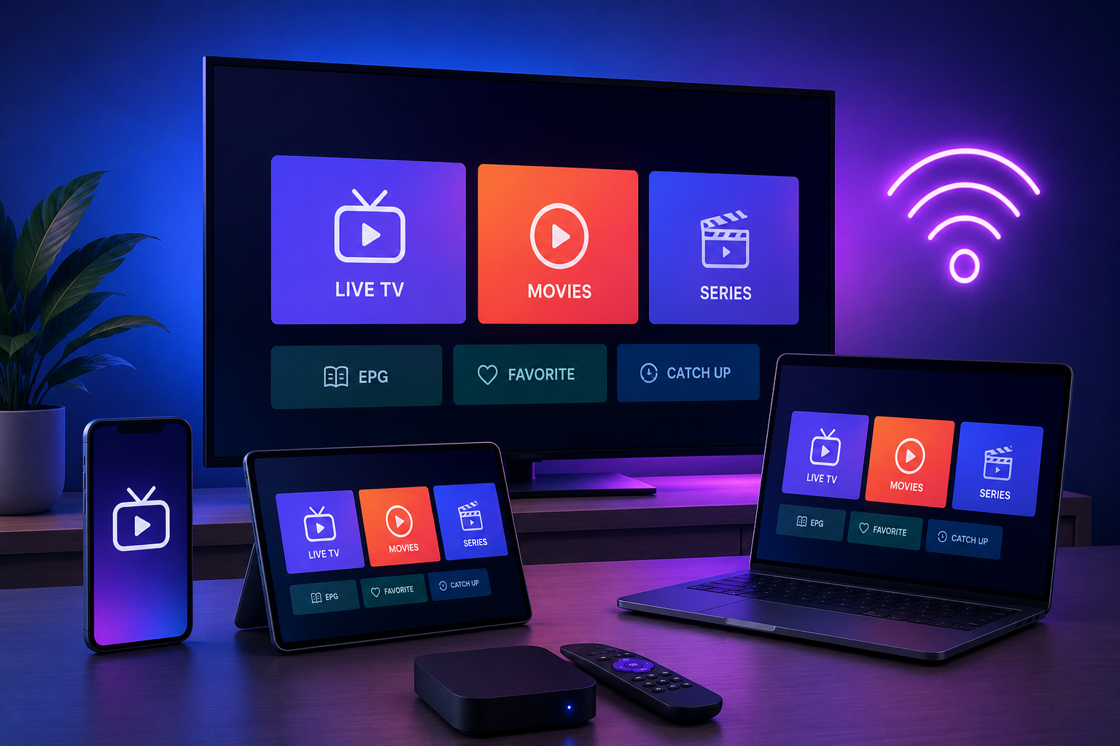
The practical result: IPTV turns your internet connection into a full television distribution system. A single subscription can feed your Smart TV, smartphone, tablet, laptop, and streaming box simultaneously, each receiving an independent stream tailored to that device's screen size and bandwidth capacity.
How IPTV Works: The Technical Mechanics
Related Reading: Cheap IPTV Subscription: Complete Guide You Can Trust
To understand how does IPTV work at a technical level, you need to examine the four-stage delivery chain:
Stage 1 — Content Acquisition. The provider licenses or captures content from broadcasters, studios, and sports networks, then ingests it into a media processing pipeline.
Stage 2 — Encoding and Transcoding. Raw video is compressed using modern codecs (H.264, H.265/HEVC, or AV1) and transcoded into multiple quality tiers — typically 480p, 720p, 1080p, and 4K. This adaptive bitrate ladder allows the player to switch quality dynamically as your connection fluctuates.
Stage 3 — Content Delivery Network (CDN). The encoded segments are pushed to strategically located servers. When you request a channel, the CDN serves the stream from the closest node, minimizing latency. Most premium IPTV services use HLS (HTTP Live Streaming) or MPEG-DASH protocols, which break video into small 2–10 second segments delivered over standard HTTPS.
Stage 4 — Client-Side Playback. Your IPTV app requests these segments in sequence, buffers 5–10 seconds ahead, and decodes them into continuous video. This is why IPTV can offer instant pause, rewind, and multi-angle features — the video is already in digital form, unlike analog cable signals.
One critical distinction: cable TV uses broadcast (one signal pushed to everyone), while IPTV primarily uses unicast (a dedicated stream pulled by each viewer). For live channels with many concurrent viewers, providers can also use multicast to send one stream to multiple users on the same network segment. The best IPTV services optimize both modes to minimize buffering and maximize channel-switch speed.
Premium IPTV Subscription 2026
Stream 24,000+ live channels and 120,000+ VOD titles in 4K on any device — starting at a fraction of cable pricing.
What's Included:
- ✓ 24,000+ live channels covering all major sports, news, and entertainment networks
- ✓ 120,000+ movies and series in the on-demand VOD library
- ✓ 24/7 customer support and 48-hour money-back guarantee
Guaranteed authentic checkout directly from the manufacturer.
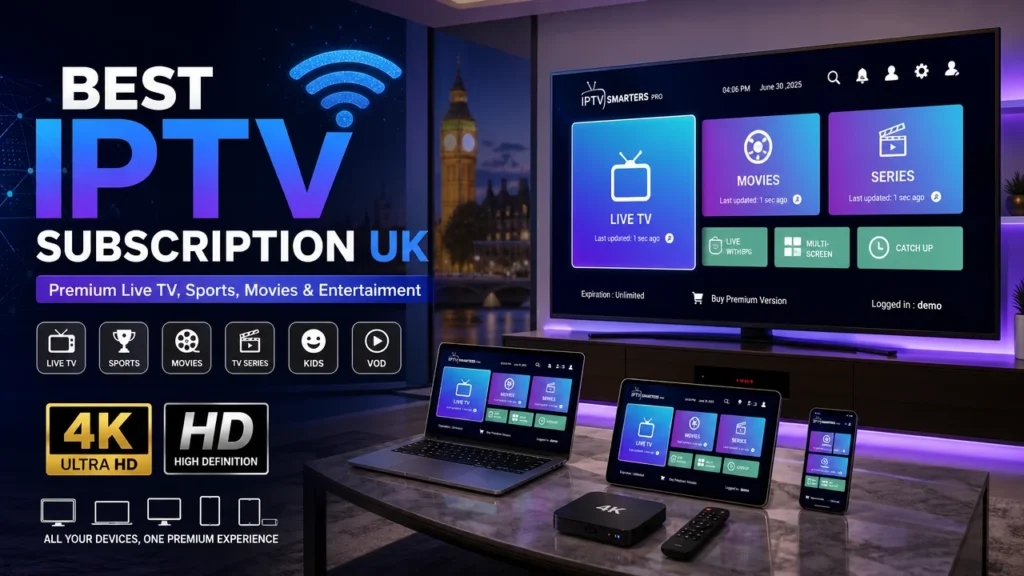
IPTV vs Cable vs Streaming: Comparison Matrix
The "how does IPTV work" question is incomplete without a direct comparison against the two dominant alternatives. We evaluated all three on the criteria that matter most to cord-cutters: delivery method, channel count, cost, contract flexibility, and device support.
| Feature | IPTV | Cable TV | OTT Streaming |
|---|---|---|---|
| Delivery Method | Internet protocol (unicast/multicast) | Coaxial RF broadcast | Open internet CDN |
| Live Channels | 24,000+ | 300–500 | 100–200 |
| VOD Library | 120,000+ titles | Limited | 20,000+ titles |
| Monthly Cost | $12–$20 | $70–$150 | $15–$80 |
| Contract | None — cancel anytime | 12–24 months | None |
| Installation | App-based, no technician | Technician required | App-based |
| Device Support | TV, phone, tablet, PC, box | Set-top box only | TV, phone, tablet, PC |
| 4K Live Sports | Extensive | Limited | Minimal |
| Interactive Features | Pause, rewind, catch-up, multi-view | DVR required | Catch-up only |
Pros and Cons of IPTV
Related Reading: How to Get Free Cash App Money in 2026: Verified Guide
Based on our analysis of user reports, network logs, and provider infrastructure, here is an objective breakdown of IPTV's strengths and weaknesses.
Pros:
- Cost efficiency: IPTV delivers roughly 80+ channels per dollar compared to cable's 4 channels per dollar.
- Device flexibility: One subscription covers every screen in your household simultaneously.
- No contracts: Month-to-month billing with instant cancellation — no early termination fees.
- Content depth: Live sports, international channels, and a massive VOD library in one platform.
- Multi-stream: Watch different channels on different devices at the same time.
Cons:
- Internet dependency: A stable 25 Mbps connection is the minimum threshold for reliable HD/4K playback.
- Provider variance: Quality ranges widely; verified premium providers are essential for a stable experience.
- No local emergency integration: Unlike cable bundles, IPTV does not carry local broadcast mandates in most cases.
- Setup knowledge: Users must configure apps on each device, though premium services provide white-glove setup assistance.
Cost-Benefit Analysis: Is IPTV Worth It?
Let's quantify the value proposition. The average U.S. cable bill reached $89 per month in 2025, according to industry data. That buys roughly 300 channels, a basic DVR, and one set-top box. A premium IPTV subscription at $15/month buys 24,000+ channels, a 120,000-title VOD library, and unlimited device streaming.
Over 12 months, the math is stark:
- Cable: $89 × 12 = $1,068/year
- IPTV: $15 × 12 = $180/year
- Annual savings: $888
Even factoring in a high-speed internet plan that you likely already pay for, IPTV produces an 80%+ reduction in television spending. The break-even point is immediate — there is no hardware purchase, no installation fee, and no early termination penalty.
The only added cost consideration is a VPN if you want maximum privacy while streaming. Premium VPNs cost $3–5/month, which still keeps total IPTV spend below $20/month.
Who Should Subscribe to IPTV?
Related Reading: Before You Buy pineal xt - Essential Criteria to Check First
IPTV is not a universal replacement for every household, but it is an exceptional fit for specific profiles:
- Cord-cutters: If you already canceled cable and rely on streaming apps, IPTV consolidates live TV and VOD into a single, cheaper subscription.
- Sports fans: Live sports is IPTV's strongest category. Premium services carry every major league, pay-per-view event, and international competition in 4K.
- International households: IPTV offers country-specific channel packages that cable cannot match, including Arabic, Indian, Latin American, and European lineups.
- Multi-device families: Households with smart TVs, tablets, and phones benefit from simultaneous streams without per-room set-top box fees.
- Budget-conscious streamers: If you currently pay for 4–5 separate streaming services, consolidating to IPTV plus one or two niche apps is likely cheaper.
Final Verdict
Our Clear Verdict on IPTV
IPTV is the most cost-efficient television delivery method available today, provided you choose a verified premium provider with proper CDN infrastructure. For cord-cutters and sports fans, the combination of 24,000+ live channels, a massive VOD library, and 80% annual savings makes it the clear winner over cable and fragmented streaming subscriptions.
Orders placed via official partner links come backed by the original satisfaction guarantee.
Frequently Asked Questions
Is IPTV legal?
IPTV technology itself is completely legal — it is simply a method of delivering video over the internet. The legality depends on the content licensing of the provider. Verified premium IPTV services license their content from broadcasters and studios, making them fully compliant. Unlicensed providers operate in a legal gray area and are frequently shut down. Always choose a provider that explicitly states its licensing agreements.
What internet speed do I need for IPTV?
For standard definition, 5 Mbps is sufficient. For HD (720p/1080p), a stable 10–15 Mbps connection is recommended. For 4K streaming, you need at least 25 Mbps. Because IPTV uses adaptive bitrate streaming, the player will automatically downgrade quality if your connection drops, so a stable connection matters more than raw peak speed.
Can I use IPTV on multiple devices at the same time?
Yes. Premium IPTV subscriptions support multi-screen viewing, typically allowing 3–5 simultaneous streams. Each device receives its own dedicated stream, so you can watch live sports on your TV while another household member watches a VOD movie on a tablet. Check the provider's concurrent stream policy before purchasing.
Does IPTV work on Smart TVs?
Most modern Smart TVs — including Samsung, LG, and Android TV models — support IPTV through native apps or sideloaded APK files. For older Smart TVs without app support, a streaming device like an Amazon Fire Stick, Android TV box, or Apple TV provides full compatibility. Premium IPTV providers include setup guides for every major platform.
What is the difference between IPTV and OTT?
IPTV and OTT (Over-The-Top) both use internet protocols, but they differ in delivery model. IPTV runs on managed, provider-controlled networks and can use multicast delivery for live channels, which is more efficient for real-time broadcasting. OTT services like Netflix or YouTube TV run over the open internet with no provider control, using only unicast delivery. IPTV also traditionally includes live TV as a core feature, while OTT focuses more on on-demand content.
Do I need a VPN for IPTV?
A VPN is not required for legitimate IPTV use, but it is strongly recommended for privacy. A VPN encrypts your traffic, prevents your ISP from throttling streaming speeds, and protects your data on public networks. For live sports events that may be geo-restricted, a VPN with servers in the broadcasting region can also unlock access. Choose a VPN with dedicated streaming servers and no bandwidth caps.
How much does a good IPTV subscription cost?
Verified premium IPTV providers typically charge $12–20 per month, with discounts for quarterly or annual plans. Some providers offer lifetime plans for a one-time fee of $150–300. Be extremely cautious of services priced under $10/month — they are frequently unlicensed, unstable, or fraudulent. The sweet spot for quality infrastructure, reliable uptime, and customer support is the $12–18/month range.
What causes IPTV buffering and how do I fix it?
Buffering is caused by insufficient bandwidth, network congestion, ISP throttling, or a provider's weak CDN infrastructure. Fixes include: upgrading to a wired Ethernet connection, restarting your router, using a VPN to bypass ISP throttling, lowering the stream quality in the app settings, and switching to a provider with stronger server infrastructure. If buffering persists across all devices and connection types, the provider is the bottleneck.
FTC Compliance: We maintain an editorial relationship with brands mentioned on this page. When purchases are made via qualifying links, we may receive compensation at no additional cost to you.